page hit counter
Showing posts with label Meditation (introduction). Show all posts

Meditation in plain English


DOWNLOAD BOOK:
Mindfulness in Plain English by Ven. Henepola Gunaratana
www.sunnataram.org (PDF, 637KB)


ONLINE VERSION:
www.urbandharma.org

PRINT VERSION:
Book link to Amazon


The purpose of Vipassana meditation is nothing less than the radical and permanent transformation of your entire sensory and cognitive experience. It is meant to revolutionize the whole of your life experience. Those periods of seated practice are times set aside for instilling new mental habits. You learn new ways to receive and understand sensation. You develop new methods of dealing with conscious thought, and new modes of attending to the incessant rush of your own emotions.


This is completely a how-to book that tries to get you going in a practical way with Vipassana or insight meditation.


What Ven Gunaratana says about what meditation 'is not' is perhaps, in this context, quite important. The different meditation traditions are discussed and then Vipassana placed in context.

"It is a process of self discovery, a participatory investigation in which you observe your own experiences while participating in them, and as they occur. The practice must be approached with this attitude. " A whole chaper has been devoted to the right attitude to meditation.

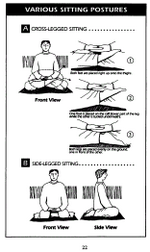
The details of exactly what is to be done in the meditation process is explained, including the posture, what to do with your mind and so on. Dealing with distractions is, of course, dealt with in detail.

Because of its constant focus on how to do things, it could be an invaluable reference to the beginner, especially when she is assailed by the kind of innumerable doubts that accompany the practice of something as subjective as meditation. Things such as mindfulness can be very tricky.

Ven. Gunaratana's explanations are exact. "When you first become aware of something, there is a fleeting instant of pure awareness just before you conceptualize the thing, before you identify it. That is a stage of Mindfulness." He goes on to explain what is is, or perhaps come as close to it as possible. The difference between mindfulness and conentration is also explained.

What is in it for you, he asks, towards the end, which is just one of the many questions that underline his earthy approach to the topic of Vipassana meditation. "Once your mind is free from thought, it becomes clearly wakeful and at rest in an utterly simple awareness. This awareness cannot be described adequately. Words are not enough. It can only be experienced."

Meditation tools


Book page


DOWNLOAD BOOK:
For the Stilling of Volcanoes
by Ven. Sujiva
PDF, 143 KB, www.buddhanet.net


Insight meditation itself is a process of processes. At first we try to keep ourselves afloat with strong continuous mindfulness. After that, the practice becomes a journey of discoveries.


This booklet lays out the tools of meditation very neatly and precisely, making it all the more easier for a practitioner to choose the one she wants and use it, step by step.


It all begins with the mind and you do not have to go all the way to realize, as Ven Sujiva tells us, that it can be quite destructive when it erupts. The benefits of keeping our minds under check can be quite substantial, not the least of which can be an ability to maintain our balance when we go about negotiating the volatile situations we encounter every day in our lives. That is commonsense, perhaps, but finding a way to do it is not at all easy.

The mind is predominantly likened to a volcano in this booklet. "When you are in a fit of anger, consumed by lust, or buried by delusion, you are undergoing an eruption. It strikes terror in and around you, and you may lose some good things in life. Although it may not take lives, it can, and may even be, more lethal than an actual volcano," he says.

The main "control" is mindfulness. And mindfulness is the line between sanity and insanity. "If you are a meditator, you’ll have a fighting chance and maybe even end up saner than anyone else. But they may still call you mad because you are different," he says.

And then he goes on to decribe three basic meditation techniques for attaining mindfulness - ways to get a hold on the main control, as he puts it. These are walking meditation, sitting meditation, mindfulness of daily activities.

Much of the book is about these modes of meditation, which are explained in detail with a lot of attention being paid to their practical aspects. The descriptions are supported with illustrations and charts - the part on walking meditation for instance, includes a sketch that shows the various levels of awareness with which we could move our feet when we practice it.

So too is the part on sitting meditation. Ven Sujiva's flow chart tells us what we should focus on during our practice. And mindfulness of daily activites is in some ways an extention of this basic approach to everything we do from day to day.

Ven Sujiva then goes on to distinguish between insight and concentration. Insight involves the realization of the "real Nature" of the the world and cutting through the bonds of conditioning that prevents us from knowing it. It also means knowing about its essential characteristics, one of which is impermanence.

Those who do not have the patience for lengthy descriptions of doctrines and texts on which the practice is based, would find this an ideal introduction to meditation. It is not that Ven Sujiva skips them. He goes straight to the initial steps on the path to mindfulness.

Mindful questions, mindful answers


DOWNLOAD BOOK:

Living Meditation, Living Insight
Dr. Thynn Thynn
Sae Taw Win II (PDF, 271 KB, www.saetawwin2.org)


PRINT VERSION:
Book link to Amazon


Peace is with us every single moment of our life, but we do not recognize it. This is because we are ignorant about peace — most of the time we are too preoccupied with the external world and our own running thoughts and emotions to be aware of it. We have lost touch with our inner selves, with what is the best in us. We frantically try to find the answer outside when all the time peace is sitting there, silently waiting until we come home to it.


The quest for mindfulness, of turning one's mind "inside out" as the author of this book, Dr. Thynn Thynn puts it, can prove tricky and elusive. It is an integral part of meditation, so, all Buddhist masters talk about practice, practice and more practice.


And in this Dr Thynn is no different. But with her, meditation and daily living are enmeshed and the focus is on ordinary people living ordinary lives. It is meditation day to day, and moment to moment, amid the ups and downs of daily living that she talks about. "The popular notion is that you need to set aside a special time or place to meditate. In actuality, if meditation is to help you acquire peace of mind as you function in your life, then it must be a dynamic activity, part and parcel of your daily experience. Meditation is here and now, moment-to-moment, amid the ups and downs of life, amid conflicts, disappointments and heartaches," she says.

It was its "simplicity, directness and practicality in daily life" that drew her to this path, she says early on in the book, when she refers to her teachers and their teachings.

The path seems too simple and much within effortless reach to be true. But she explains precisely why we should not think that way. "The path to inner peace is quite simple. You complicate it by thinking that the method should be difficult," she says.

But where does it all begin. Here. In mindfulness.

And how do you begin? Simple!

"Try being mindful of whatever you are doing at the moment —
walking, sitting, bathing, cleaning, looking at a flower. You can do this at any time and in any place. As you train your mind to focus, you will find you are less distracted. Later, as you go on, you can be mindful of your thoughts and emotions as they arise."

But she has to answer questions that have everything to do with balancing the practice of meditation with the humdrum tasks of everyday living. "Sometimes it’s a luxury to be mindful of a task with undivided attention. I only get frustrated if I try to be mindful of a task when my young children demand my attention," a practitioner says. "Don’t compete with yourself. What you choose to pay attention to is entirely circumstantial. If the children need you, focus on them," advises Dr Thynn.

As Dr Thyn proceeds, step by step, to explain the intricacies of meditation she also takes care to relate these to the fundamental tenets of Buddhism. Her way is described as "unorthodox", having influences of Zen, Krishnamurti, and involving a "liberal interpretation Theravada Buddishm". But her explanations are accessible, and even if you do not know much about Buddhism, she gives you as much of the basics you need to know on the way.

She also explains how the meditation she talks about differs from the form it is usually associated with in Buddhism - sitting meditation. With her, the emphasis is on “looking directly within and practicing mindfulness in everyday life.”
At its core, mindfulness enables one to attain a kind of "split-second samadhi," one that leads to pure heightened consciousness (Panna).

But one could get lost along the way. That is why the questions are centered around certain basic themes. The answers too explore different dimensions of a basic question. That is why this book makes it easy for a beginner to understand meditation. It almost seems that Dr Thynn is guiding you by hand as one chapter after another of questions and answers unfold.

The questions can be profoundly simple and so too the answers:
To this fundamental question: If “I” is an illusion and not reality, how can “I” get rid of the “I”?....... she replies, "How can you get rid of something that never was?"